Furthermore, 3D scanning technology is also used in reverse engineering to recreate old parts or create new components quickly and accurately. 3D printing technology, widely applied in this industry, especially for producing complex molds and castings, can also be used to manufacture entire aircraft fuselages or other large components. This technology allows for the flexible creation of customized parts and components for each aircraft model.
With its advanced 3D measurement solutions, SCANOLGY provides comprehensive technologies to create 3D models ready for 3D printing. This enables original equipment manufacturers (OEMs) and aerospace suppliers to efficiently produce complex and customized parts.

The Outstanding Advantages of SCANOLOGY Handheld 3D Scanners
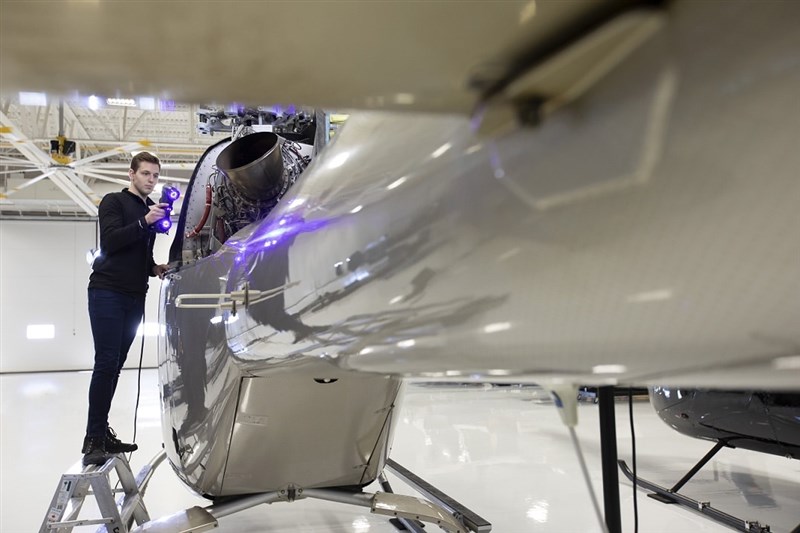
SCANOLOGY's handheld and mobile 3D scanners are reliable tools for quickly and easily collecting 3D data. They are the optimal choice for measuring complex curved surfaces, turbine blades, and even blind spots that are difficult to access with traditional methods. Thanks to their non-contact measurement capabilities, our 3D scanners ensure non-destructive testing (NDT). In just minutes, these handheld 3D scanners can collect full-field data, creating color maps showing deviations without damaging aircraft components.
We cater to diverse needs in the aerospace industry:
Product Development: SCANOLOGY supports aerospace manufacturing with its proprietary ScanViewer software and measurement-standard 3D scanners. By collecting point cloud data ready for computational fluid dynamics (CFD) analysis, our 3D scanners are powerful tools that accelerate research and development (R&D). They also help measure and verify structural deformation to optimize design.
Virtual Assembly: Our advanced 3D laser scanning technology allows users to capture point clouds and create 3D models for virtual assembly. This enables manufacturers to promptly detect potential problems and adjust models accordingly, simplifying the entire workflow.
Maintenance, Repair, and Recycling (MRO): Our high-precision 3D measurement technology is used to collect data on operating aircraft to identify potential faults, deformations, and defects. This significantly improves maintenance and repair efficiency, ensuring aircraft operation and passenger safety.
Practical Applications in Non-Destructive Testing (NDT)
Non-destructive testing (NDT) is an extremely important process in the aerospace industry to ensure the safety and quality of every component. SCANOLOGY provides comprehensive NDT solutions for a wide range of aircraft components, including:

From millennia-old cultural values fading with time to the harsh limitations of physical space in archaeological work, 3D scanning digitization projects offer a groundbreaking solution to awaken dormant cultural values. In this context, 3D scanning technology is not just a tool, but a bridge across time, where the 3DeVOK MT device has demonstrated exceptional capabilities beyond expectations.
View more
On June 25, shares of the American semiconductor giant Nvidia officially set a new record, rising by 4.3% to close at $154.3 per share. This surge pushed Nvidia’s market capitalization to $3.77 trillion, allowing the company to surpass Microsoft and reclaim its position as the world’s most valuable company by market cap.
View more
 Tiếng Việt
 English
